
The turkey is resting, the roasting trays are still hot, and someone has already reached across the table for the gravy. Within minutes, cranberry sauce, red wine and chocolate will test every inch of the fabric. A well-chosen Christmas table cover isn't just a decorative layer. It protects the table, gives the setting a finished look and makes the aftermath far less stressful.
For UK hosting, the right choice balances festive colour and texture with practical cleaning, secure placement and safe use around heat. The most attractive cover won't help if it drags into diners' laps, shrinks in the first wash or sits beneath an unstable candle. The useful question is not just which pattern looks Christmassy, but which textile will cope with the way your household eats, serves and cleans.
Table of Contents
- Setting the Scene for Festive Dining
- The Case for Reusable Festive Textiles
- Choosing the Right Material and Dimensions
- Styling Safely Around Candles and Heat
- Coordinating Tableware and Festive Accents
- Post-Dinner Care and Seasonal Storage
Setting the Scene for Festive Dining
Christmas dinner rarely happens on an empty, perfectly measured table. Extra chairs appear from another room, serving dishes occupy the spaces meant for glasses, and plates are passed over a crowded centre. A table cover has to work within that reality. It should sit securely, allow diners to move comfortably and create a dependable base before the napkins, placemats and decorations arrive.
A good fit changes the whole experience. If the cover is too short, the table can look unfinished and the edges may pull upwards when guests sit down. If it's too long, it can catch on knees, brush against chair legs or encourage children and pets to tug at the fabric. A moderate, even drop usually gives the most controlled appearance, particularly when the table needs to accommodate extra place settings.
Practical rule: Style the table around the cover's behaviour first, then refine the colour scheme.
The material matters just as much. A glossy wipe-clean surface may suit a young family better than a delicate fabric that needs immediate attention after every spill. A patterned textile can disguise small marks during a long meal, while a plain cover gives you a calmer background for patterned crockery and decorative accents. If your table already carries a strong wood grain or bold finish, a restrained print may look more polished than another busy motif.
The cover also sets the direction for the rest of the room. Traditional red and green create an unmistakably festive setting, while deep green, burgundy, navy or neutral fabric can be used beyond Christmas. Small details, such as a seasonal centrepiece or a Father Christmas decoration, can then provide the Christmas reference without forcing every item on the table to match.
The Case for Reusable Festive Textiles
December puts unusual pressure on household budgets. The Bank of England's Christmas spending analysis reports that the average UK household spends approximately £713 more in December than in a typical month, when normal monthly spending is about £2,460. That's a 29% increase in household expenditure, while spending on specialist food rises by around 22% and spending on drink by approximately 38%.
Those figures don't isolate table covers, but they show why festive dining textiles should be treated as part of the hosting budget rather than as an impulse decoration. The cover supports the meals, drinks and gatherings that make December spending unusually high. A sensible purchase should therefore earn its place through repeated use, straightforward care and a design that remains useful after the main celebration.
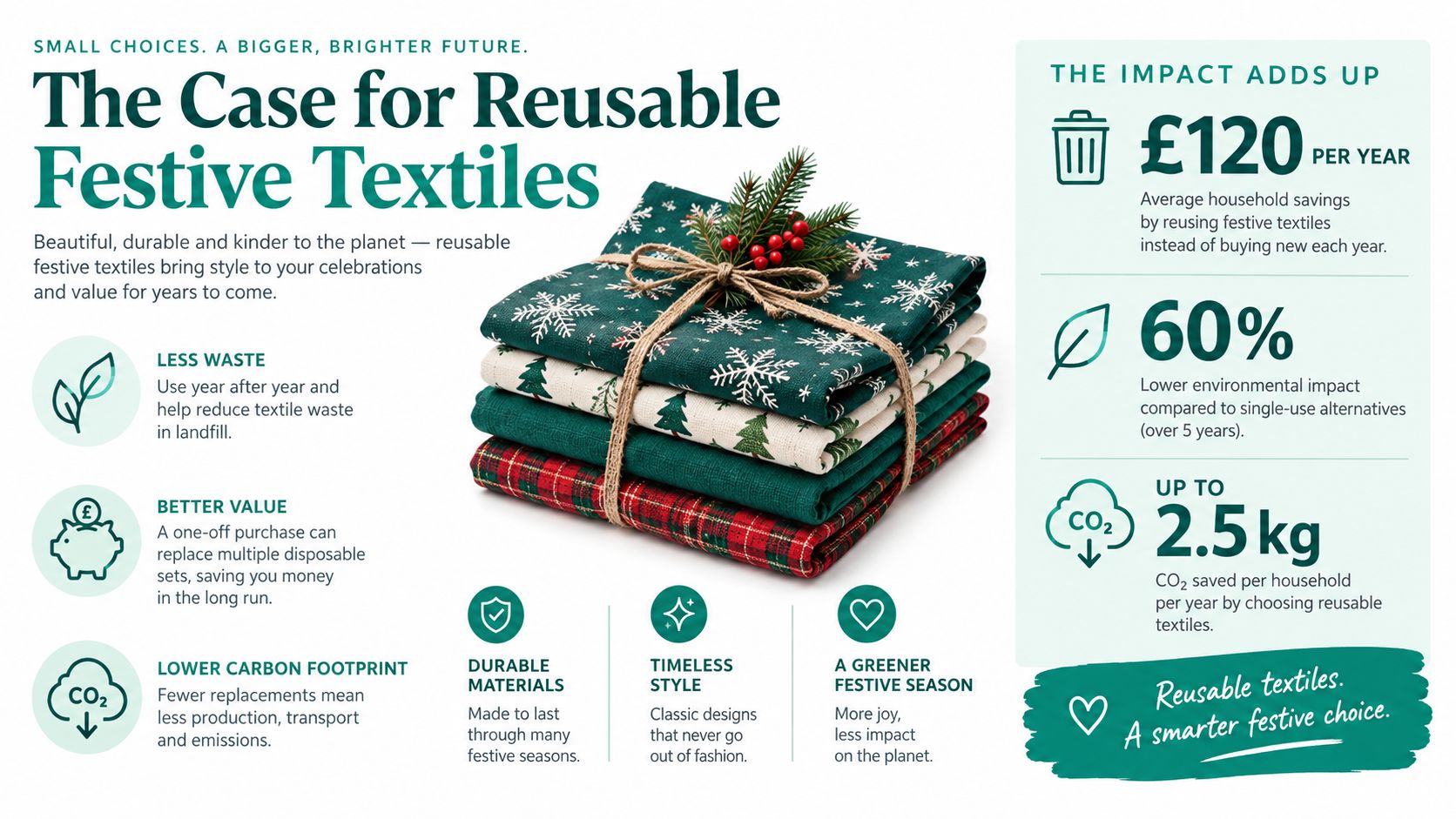
Single-use plastic can appear economical at the till, but disposal is part of the true cost. A UK household-waste report on Christmas disposal cites a poll in which 81% of households using a plastic tablecloth threw it away at the end of the holiday season. The same report says UK waste increases by about 30% during Christmas, creating more than 3 million tonnes of additional festive waste.
That doesn't mean every washable textile is automatically a better choice. A reusable cover only reduces replacement and disposal when it can withstand laundering, fits the table properly and is stored for another occasion. A thin fabric that loses its shape after one difficult stain may perform worse than a sturdier cover that can be washed and used for winter entertaining, birthdays or Sunday lunches.
Buyer's test: Ask how many occasions the cover can realistically serve, not just how festive it looks on its first day.
For a budget-conscious household, durability spreads the purchase across future meals. A reversible design, a subtle winter pattern or a cover that works with plain placemats can extend its useful life. The aim isn't to make an unsupported environmental promise. It's to choose a dining textile that avoids needless replacement and deals with real post-dinner mess more responsibly than a disposable option.
Choosing the Right Material and Dimensions
Start with the table, not the product photograph. Measure the tabletop's length and width, then decide how much fabric should fall over each edge. A modest drop gives a neat everyday appearance and leaves more clearance around chairs, while a longer drop creates a more formal drape but needs careful checking around knees and chair arms.
Use this simple process:
- Measure the top: Record the table's length and width at the widest points.
- Choose the drop: Add the preferred drop to both ends and both sides. Keep the amount even so the cover doesn't look skewed.
- Check the chairs: Sit at the table before buying if possible. Confirm that the fabric won't press against legs, catch on armrests or invite children to pull it.
- Allow for the setting: If you'll add thick placemats, runners or a substantial centrepiece, make sure the cover still leaves plates stable and serving space usable.
Fibre composition helps you predict how the cover will behave, but it isn't a complete performance guarantee. Polyester-heavy constructions generally favour dimensional stability, colour retention and faster drying. Cotton-heavy fabrics tend to offer a more natural hand feel and absorbency, but they can be more vulnerable to shrinkage and creasing unless laundering is controlled.
For covers made from at least 80% textile fibres, the UK Government textile-labelling guidance requires each constituent fibre and its percentage by weight to be identified, generally in descending order. If the cover includes separate layers, backing, edging or attached trim with different compositions, those components may also need separate information. Check that the online description matches the physical label, and don't treat terms such as “cotton-rich” or “recycled polyester” as reliable without verified specifications.
| Material Blend | Best For | Care Considerations |
|---|---|---|
| Polyester-heavy blend | Busy family meals, frequent washing and quicker drying | Follow the stated temperature and avoid assuming the fabric is stain-proof |
| Cotton-heavy blend | A softer feel, absorbency and a more traditional textile appearance | Check shrinkage, creasing and ironing requirements before purchase |
| Mixed textile construction | Buyers wanting a balance between drape and practical handling | Review every component, including backing, edging and trim |
A wipe-clean finish may suit households with small children, but “wipe-clean” and “waterproof” aren't interchangeable claims. Likewise, a fibre name doesn't prove stain resistance, flame performance or heat tolerance. Pair the cover with complementary details from N-TASH's table runner collection only after checking dimensions and the care instructions for each piece.
Styling Safely Around Candles and Heat
A beautiful tablescape can become unsafe when loose fabric, trailing decorations and naked flames occupy the same crowded surface. A Christmas table cover isn't fireproof because it has a festive print, and it shouldn't be advertised as fire retardant or match resistant without a relevant test report for the finished construction.
The UK Government's candle safety guidance reports that candles start around 850 accidental home fires each year in England. It advises keeping candles away from ribbons, cards, Christmas decorations and other materials that can catch fire, and extinguishing them when people leave the room or go to bed.
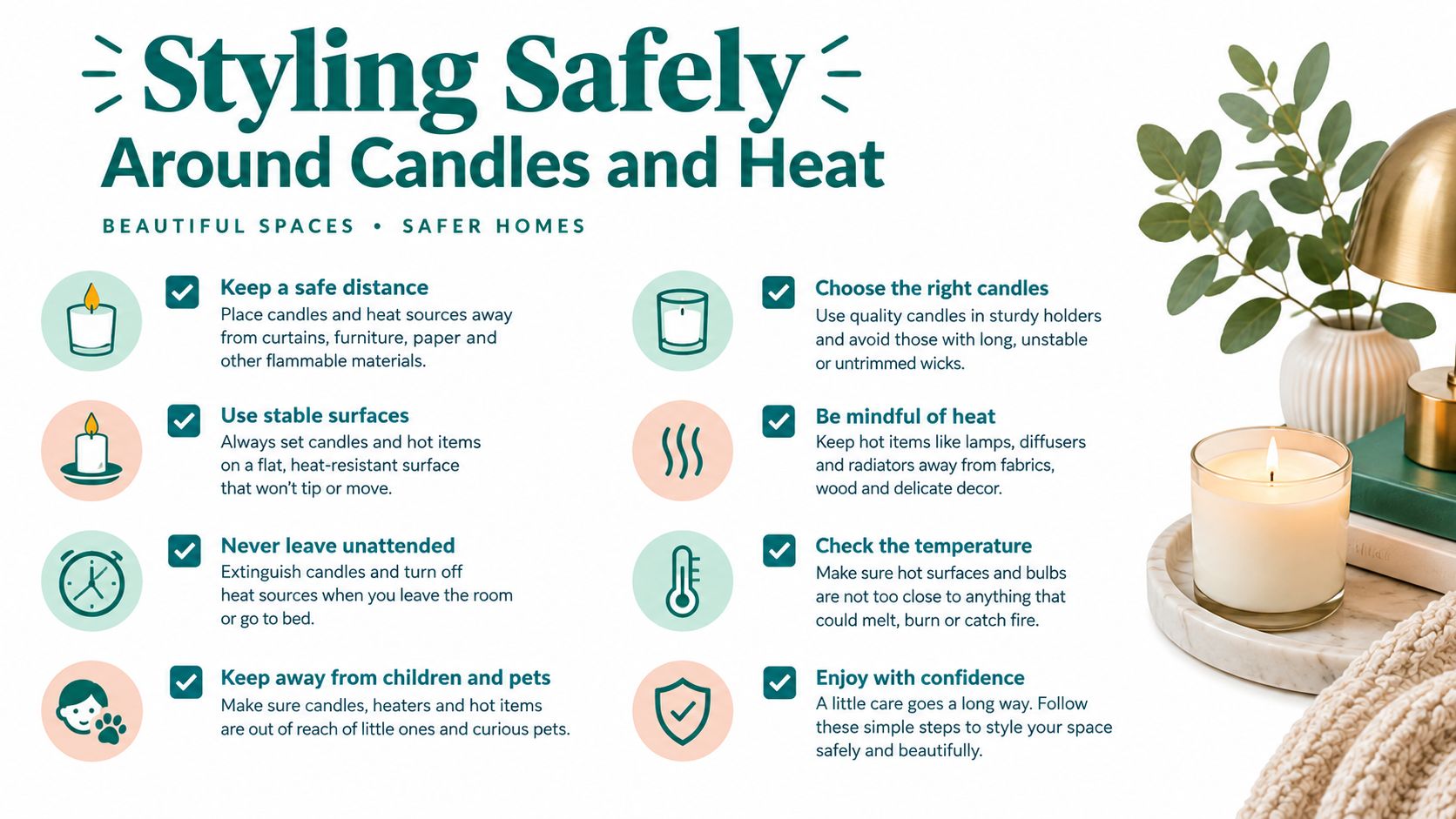
A safer layout starts with stability. Keep the cover flat rather than allowing loose folds to gather beside a flame, place candles in sturdy holders on heat-resistant trays, and keep hot roasting dishes on suitable trivets rather than directly on the textile. Don't let ribbon, napkin corners or decorative greenery trail into a candle's flame path.
Flameless LED candles provide the glow without exposing the fabric to an open flame. They're especially practical where children, pets or crowded place settings make it difficult to maintain clear space. If you prefer real candles, use fewer, shorter arrangements and position them where an adult can see them throughout the meal.
Safety principle: No Christmas table cover should be treated as a substitute for clearance, supervision and a stable heat-resistant surface.
The same restraint applies to electrical decorations. Keep cables away from places where guests may catch them, and don't hide plugs or connections beneath a loose textile. Decorative inspiration, such as a Christmas mantel garland, can remain elsewhere in the room while the table itself stays clear around serving heat and flames.
Coordinating Tableware and Festive Accents
The most convincing festive tables usually rely on a controlled combination of colour, texture and repetition, not a collection of matching Christmas products. Start with the cover as the largest visual area. Once that foundation is chosen, repeat one or two of its colours through napkins, placemats, coasters or crockery.
A red cover can take several directions. White plates and green napkins create a traditional contrast, while natural-toned accessories make the red feel softer and less themed. A deep green cover works with warm wood, cream ceramics and brass-coloured cutlery. Navy or burgundy can look more refined with white tableware and a small amount of metallic detail.
Layering should also solve practical problems. Placemats define each diner's area and protect the main cover from plate movement, while coasters prevent drink marks from spreading across the central surface. Napkins add a change of texture and can introduce a pattern without committing you to a heavily printed tablecloth.
Build a cohesive setting without overspending
Use the pieces you already own as the starting point. Plain white plates can support almost any festive palette, and a new seasonal textile may be enough to refresh familiar crockery. Instead of buying a complete matching set, choose one considered accent, such as green napkins, patterned placemats or a small centrepiece.
Keep the middle of the table low and stable. Tall decorations can obstruct conversation, while loose greenery may shed onto plates or fall towards candles. A shallow bowl, a compact arrangement or a few carefully placed ornaments gives the table character without consuming valuable serving space.
The cover should remain visible. Covering it with multiple runners, oversized centrepieces and layered accessories can make a table feel crowded rather than generous. A restrained arrangement often looks more expensive because each item has room to perform its job.
A seasonal soft toy or small decorative figure can work at a sideboard or at the end of the table, especially in a family setting. Keep it away from food, flames and hot dishes, and let the main dining area remain clear enough for guests to pass serving bowls comfortably.
Post-Dinner Care and Seasonal Storage
Deal with spills before they dry into the fibres. Lift solids with the edge of a spoon, then blot liquid with a clean cloth rather than rubbing it deeper into the fabric. Treat cranberry sauce, gravy, wine, chocolate and wax according to the care label, and test any cleaning product on an inconspicuous area first.
For candle wax, let it harden before gently lifting the excess. Avoid scraping aggressively or applying direct heat unless the manufacturer specifically allows it, because coatings, printed designs and synthetic fibres can react differently. Greasy marks from roast dishes often need prompt attention, but the wash temperature and detergent should always follow the textile's instructions.
Wash with the next use in mind
Check the fibre composition and care symbols before putting the cover in the machine. Separate strong colours where appropriate, avoid overloading the drum and don't assume a hot cycle will improve stain removal. Excess heat can encourage shrinkage, affect finishes or set damage that would have been easier to treat when fresh.
Dry the cover fully before folding it. Damp storage invites musty smells and can leave permanent creases. Smooth the fabric while it's still slightly damp if the care label permits, then fold along broad, natural lines rather than compressing it into a tight bundle.
Storage habit: Label the folded cover by size or table use, then keep it in a dry cupboard away from direct sunlight and household moisture.
A breathable storage bag or clean fabric sleeve helps protect the textile from dust without trapping residual damp. Store matching napkins or runners nearby, but don't pack them tightly against anything that could transfer colour. Before next Christmas, unfold the cover early enough to inspect the seams, edges and any stains that may have been missed after the meal.
N-TASH offers seasonal homeware and dining accessories for UK households putting together an affordable festive setting, including tableware, placemats, coasters and decorative accents. Browse N-TASH to choose practical pieces that complement your Christmas table cover and can be used alongside everyday hosting essentials.