
The most popular Christmas decorating advice is backwards. A fuller Christmas mantel garland isn't automatically a better one, especially when the mantel sits above an open fire, wood-burning stove, gas fire or radiator. Heat clearance, secure fixing and safe lighting must decide the shape before colour, foliage or ribbon enters the room.
A safe display can still look abundant and inviting. The trick is to create controlled layers, reuse a strong base and spend selectively on accents that can change from year to year. UK households already treat decorating as a recurring seasonal activity. A survey of 2,000 adults found that 60% put up Christmas decorations every year, while 54% enjoy buying or experimenting with new combinations of lights and tinsel annually, according to research into UK Christmas decorating habits. Your mantel should support that habit, not force you to replace the whole scheme each December.
Table of Contents
- Assessing Your Fireplace and Heat Clearance
- Choosing a Theme and Budget-Friendly Base
- Securing the Garland to the Mantelpiece
- Layering Textures and Festive Accents
- Integrating Lights and Candles Safely
- Final Checks and Packing Away for Next Year
Assessing Your Fireplace and Heat Clearance
Before you unroll the greenery, identify what your mantel is. A blocked-up chimney breast or purely decorative shelf gives you more freedom than a mantel above a working fire. An open fireplace, wood-burning stove, gas fire and radiator each create a potential heat zone, and a garland made from artificial foliage, dried branches, paper, fabric or ribbon can become dangerous when it shifts towards that zone.
Don't start by asking how far the garland should drape. Start by asking where heat, flame and rising warm air can reach. Fire Scotland advises keeping decorations away from open flames, heaters and radiators, and specifically warns against placing decorations immediately above or around a fireplace in its festive safety guidance. Cambridgeshire Fire and Rescue also recommends flame-retardant decorations and proper separation from heat sources.
Map the safe zone first
Stand in front of the fireplace and look at the full area, not just the shelf. Mark the space above the firebox, around stove openings, beside radiators and anywhere a ribbon tail or long branch could sag. If the appliance is used, assume that heat may affect synthetic materials even when the flames appear enclosed.
Use this decision process:
- Working open fire: Keep the garland away from the opening and from the area directly above it. Don't place candles beneath the greenery.
- Wood-burning stove: Treat the stove body, flue area and nearby airspace as heat-sensitive. A cascading garland is a poor choice if it can move towards the stove.
- Gas fire: An enclosed front does not make surrounding décor fireproof. Keep foliage, stockings and ribbon clear of the appliance and follow its manufacturer's clearance instructions.
- Electric fireplace or inactive mantel: You may have more styling flexibility, but check whether the unit emits heat and keep cables, fabric and foliage clear of vents.
- Radiator below or beside the shelf: Don't let greenery cover the radiator or hang into its warm airflow.
Design rule: If you can't guarantee that the garland will stay away from heat, choose a shorter, structured display or decorate a media unit, console or staircase landing instead.
Fullness comes later. First, fix the shape you can safely use. A compact line along the rear of a non-functional mantel may suit your home better than a dramatic cascade, and that restraint usually looks more considered than greenery forced into an unsuitable position.
Choosing a Theme and Budget-Friendly Base
A dramatic garland is often the wrong starting point. Once you have defined the safe area, choose a base that suits the room, the available clearance and the way you plan to use the fireplace. Classic pine supports traditional red, brass and tartan. Frosted woodland greenery suits pale wood, cream textiles and muted metallics. An eucalyptus-style base keeps a modern room lighter than dense, dark foliage.
Spend most of the decorating budget on the base because it provides the shape and coverage. Look for believable foliage, flexible branches and enough density to conceal discreet fixings. Avoid bulky greenery that presses towards a heat-sensitive area. Flexible branches also let you adjust the silhouette without forcing the garland into an unsafe position.

Spend on structure, refresh the surface
A reusable base keeps seasonal spending under control. UK Christmas research reports an average household decoration spend of £24.64 across the festive season, according to the 2025 Christmas shopping analysis. Put that budget into a simple garland you can restyle with ribbon, baubles and removable stems instead of replacing the whole display each year.
A modest green garland can look polished with texture placed selectively. If the foliage feels sparse, add a few separate stems at the ends or across the centre. If the green looks too bright, soften it with natural-toned ribbon and matte ornaments. Keep additions light enough that they do not pull the arrangement towards the edge or into a clearance zone.
Use the room's existing colours as your guide. Choose one main foliage colour, one accent colour and one finish, such as warm metal or soft white. Browse the N-TASH Christmas collection for seasonal pieces that can refresh the arrangement without forcing a new theme.
Choose a base that will survive storage. Delicate foliage that crushes or sheds whenever you reshape it will cost more in replacements. A slightly less dense garland with flexible branches gives you better control, a cleaner outline and more options for next year.
The video below provides visual inspiration for arranging a festive mantel. Use its styling ideas only after checking your own fireplace clearances and appliance instructions.
Securing the Garland to the Mantelpiece
A garland that slips is a safety problem, not a styling imperfection. Secure the bare base before adding ribbon, ornaments or lights, because extra weight can pull an unstable arrangement towards the edge or into a heat zone.
Start with a clean, dry mantel surface. Test any removable hooks on an inconspicuous area and follow the product instructions for the material and weight involved. Painted wood may accept discreet removable hooks, while stone or marble may need a different fixing approach. Don't assume a hook designed for a wall will perform identically on a polished shelf.
Build a fixed shape
Use a simple anchoring sequence:
- Set the endpoints: Place the garland within the safe area and decide whether it will run straight, form a shallow swag or taper towards one side.
- Secure the centre: Add a discreet fixing at the middle or at the main weight-bearing point so the foliage can't slide sideways.
- Anchor the ends: Fix both ends separately. This prevents the whole garland from dragging in one direction when you add accents.
- Shape the branches: Bend foliage around the fixing points, keeping the front profile intentional and the rear clear of the wall where heat or cables may be present.
- Test the movement: Give the garland a gentle controlled nudge. If it shifts, reinforce the anchor before decorating.
Floral wire can hold branches and ribbon in position, but it shouldn't replace a proper anchor to the mantel. Weighted objects may help on an inactive shelf, yet they aren't suitable if they can fall, heat up or interfere with the fireplace. Keep every fixing hidden, accessible and strong enough for the finished arrangement.
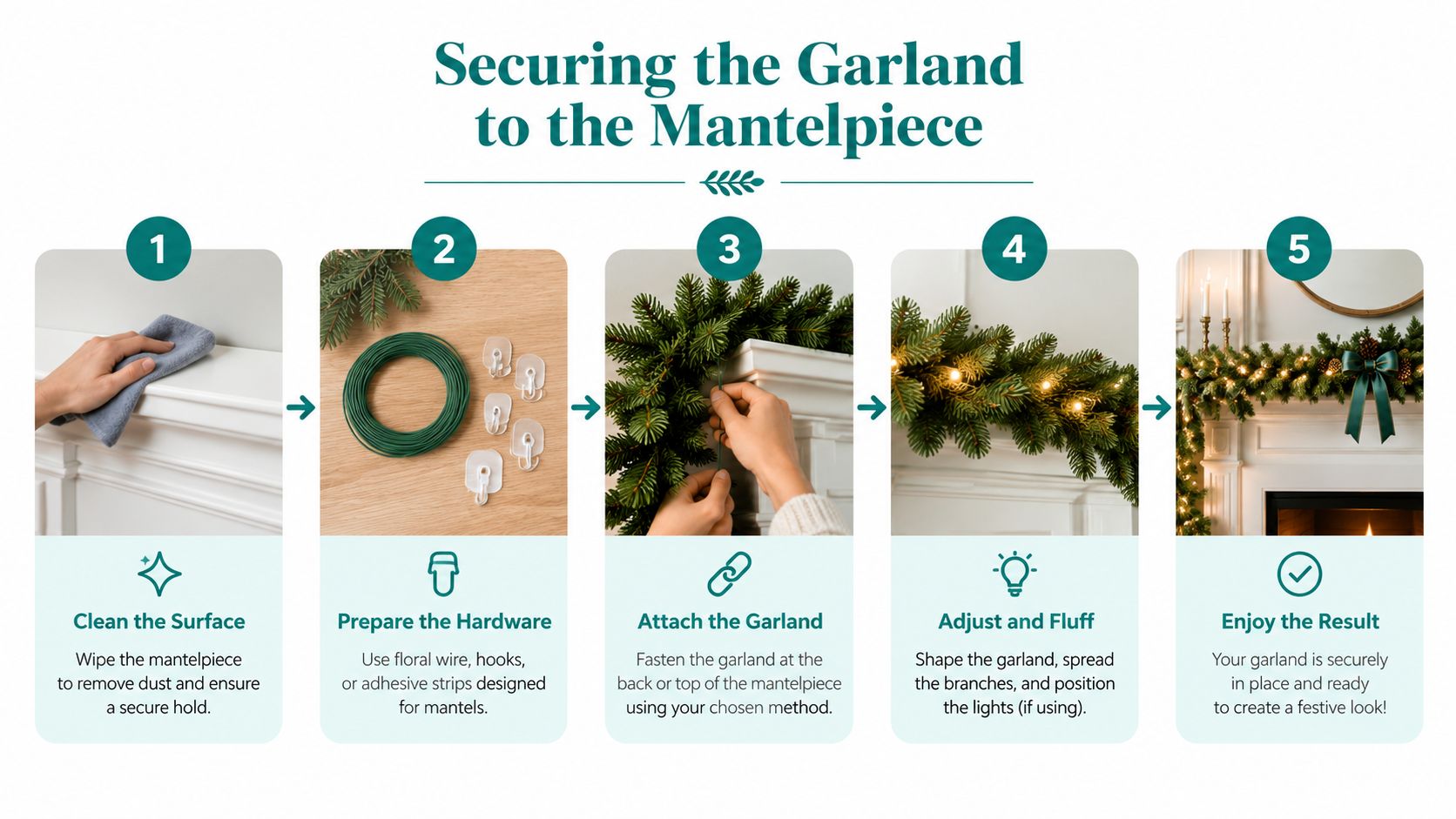
Make the cascade deliberate rather than loose. A shorter drop with a firm anchor looks better than a long trail that slowly sinks. Keep ribbon tails clipped into the greenery instead of allowing them to hang towards a firebox.
For comfort near the mantel, the Minion Hello Cushion: The Perfect Snuggle Buddy for Fans is a separate soft accessory for the sofa or bed, with a removable machine-washable cover. Keep cushions, throws and other textiles away from active heat sources too.
Layering Textures and Festive Accents
A fuller mantel is rarely a better mantel. Once the fire-safe boundary is established, restraint creates a more convincing display than piling decorations into every gap. Build from the largest layer to the smallest, leaving enough greenery visible for the arrangement to feel deliberate rather than crowded.
Begin with the secured foliage. Add one contrasting texture only where the base needs movement, such as a softer leafy stem through the centre or a slightly longer branch at the safe end. Keep additions clear of the working fireplace and any area that could become hot. A small, well-placed layer will refresh last year's garland without the cost of replacing it.

A practical layering example
Take a plain pine-style garland in a neutral living room. Add one wide velvet or woven ribbon in a single colour, arranging it in loose folds rather than wrapping it tightly along the full length. The fabric softens the look of the needles and guides the eye across the mantel without creating unnecessary bulk.
Repeat a small accent in groups of three. Choose three matte baubles, pinecones or berry clusters, then place them at varied heights within the safe display area. This gives the garland rhythm without requiring a large collection. Keep larger pieces near the fuller parts of the greenery, and use smaller accents where the garland tapers.
Natural materials add character on a budget, but inspect them before placing them. Dried oranges, pinecones and paper decorations can burn, so use them only where they remain properly separated from flames, hot surfaces and heaters. Never use them to fill or disguise an unsafe gap.
Use this order:
- Green foundation: Keep the base visible and shape it into a calm line.
- Soft texture: Add ribbon or fabric where it creates movement.
- Hard texture: Place pinecones, wooden ornaments or matte baubles to break up the softness.
- Reflective detail: Use a small amount of brass, glass or metallic finish for light.
- Personal layer: Add a few meaningful ornaments instead of emptying the whole storage box.
A single inherited bauble or handmade paper star can carry more visual weight than a large set of matching pieces. Place personal items last, so they act as focal points rather than competing with the garland. Pair older decorations with fresh ribbon or a small amount of new foliage to make them feel chosen, not leftover.
For further low-cost seasonal inspiration, browse Father Christmas decoration ideas, then edit the suggestions for your room, mantel size and heat limits. Choose only the elements that earn their place.
Integrating Lights and Candles Safely
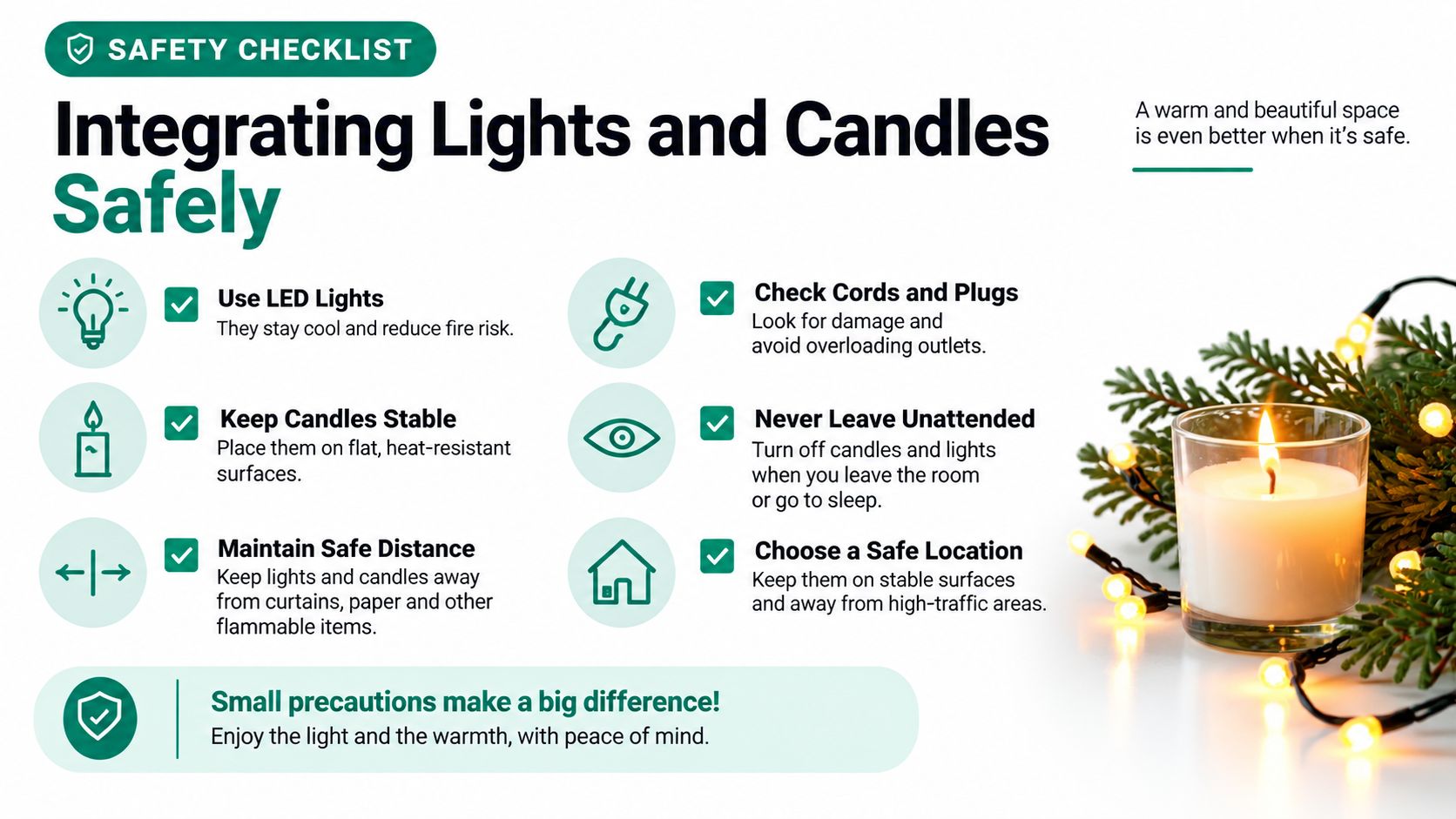
Lights add depth to greenery, but they also introduce cables, plugs, heat and failure points. Treat the light chain as an electrical appliance, not as a harmless decoration. Electrical Safety First recommends inspecting the whole set before use, checking for damaged insulation, loose wires, broken lamps and damaged plugs, as detailed in its Christmas lights safety guidance.
Inspect before you weave
Lay the lights on the floor and examine the entire chain. Replace failed lamps where the manufacturer permits it, and discard any set with exposed conductors, split insulation, a damaged plug or signs of overheating. Mains-powered lights should use a UK three-pin plug with the correct fuse.
Use an RCD-protected socket and avoid overloaded sockets, unnecessary adaptors and daisy-chained extension leads. Don't trap cables beneath ornaments, pull them tightly around sharp mantel edges or cover transformers with foliage. Place the transformer where air can circulate and where children and pets can't pull the display down.
The safe sequence is straightforward:
- Inspect the chain: Look over every section before installation.
- Position the cable: Keep it away from flames, heaters, radiators and sharp edges.
- Connect safely: Use an RCD-protected socket and compatible components.
- Check the finished display: Make sure foliage, ribbon and ornaments aren't pressing onto lamps.
- Switch off completely: Turn off and unplug the lights before bed or whenever you leave the property.
LED lights generally produce less heat than filament lamps, but they don't make artificial foliage, dried material, paper or ribbon fireproof. Keep all combustible décor away from lamps, plugs, transformers and heat sources.
Candles need their own plan
Never treat a candle as just another metallic accent. UK government guidance reports that approximately 850 accidental home fires each year in England are started by candles, and it lists Christmas trees, greeting cards, ribbons and other decorations as materials that need separation from flames in its fire safety guidance for celebrations.
Place candles in stable, heat-resistant holders on a clear surface, away from greenery and trailing ribbon. Don't put a candle immediately beneath a garland, and don't allow a ribbon tail to hang over a firebox. Extinguish candles before leaving the room and before going to bed. Never use a flame to compensate for poor electrical lighting or an arrangement that cannot safely accommodate a cable.
After switching on the lights or using the fireplace, make a physical check during the first 15 to 30 minutes. Look for scorching, unusual heat, movement, sagging or contact with the appliance. The correct acceptance test is zero contact with flame or heat, zero unattended burning and complete switch-off before sleep or departure.
Final Checks and Packing Away for Next Year
A finished garland needs a maintenance check, not just a photograph. After the first 15 to 30 minutes of operation, inspect the fixing points, branch position, ribbon tails, cable route and nearby surfaces. If anything has moved towards heat, switch off the lights or extinguish the flame, then reshape and secure the display before using it again.
Use this quick pre-holiday check:
- Heat clearance: Confirm that no foliage, paper, fabric, ribbon or ornament touches a flame, heater or hot surface.
- Structural security: Test the base gently and reinforce any slipping end or sagging centre.
- Electrical condition: Check that the cable, plug, lamps and transformer remain undamaged and uncovered.
- Visual balance: Remove one unnecessary accent if the arrangement feels crowded.
- Daily routine: Switch off and unplug lights before sleeping or leaving the property, and extinguish candles every time.
Pack the garland only after it has cooled and dried. Remove ornaments and ribbon separately, wrapping delicate pieces so they don't crush the foliage. Coil light chains loosely instead of winding them tightly around the greenery, and label the cable with the location and any matching accessories.
Store by layer, not by haste
Keep the base garland in a breathable container that protects its shape. Place stems in a separate section, with the heaviest items at the bottom and fragile decorations above them. Avoid compressing branches under heavy boxes, because flattened foliage makes next year's installation harder and may encourage you to add unnecessary replacement pieces.
A labelled Christmas storage box collection can keep lights, ribbon and ornaments together without turning the next decorating session into a search through unrelated household items. Store the fixing supplies with the display too, but replace damaged hooks, wire or cable ties rather than assuming they'll be suitable next season.
Your best Christmas mantel garland is the one that looks composed, stays where you put it and can be refreshed without starting from scratch. Safety determines the footprint, a reusable base provides the structure, and carefully chosen accents supply the seasonal change.
N-TASH offers seasonal homeware, festive gifts, textiles and storage options for UK households that want practical, budget-conscious updates. Visit N-TASH to browse Christmas décor and household essentials that can support a safer, more organised mantel display.